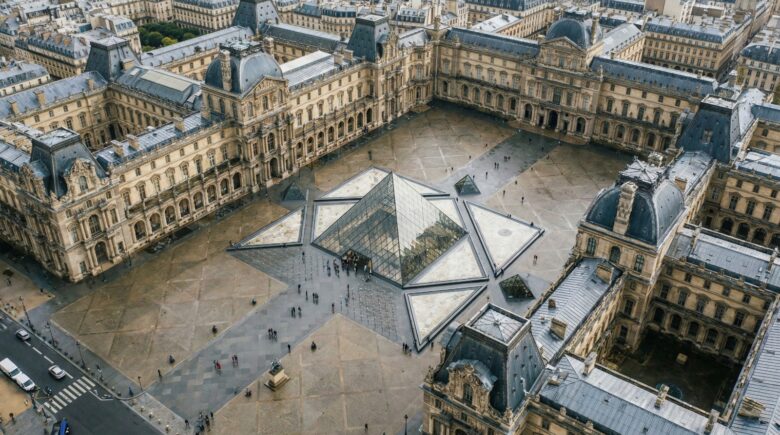
The Louvre is incredibly intimidating because it is officially the largest art museum on Earth. It sits in the very center of Paris and completely dominates the city’s cultural landscape. When people say they are visiting the museum, they often do not realize the true scale of what that means. They are not visiting a single building but are instead entering a massive complex that spans centuries of history.
You need to understand the scale before you arrive. The museum covers over 72,000 square meters of exhibition space, which is roughly the size of fifteen football fields. Among the most interesting Louvre museum facts is that the building houses approximately 380,000 objects while displaying about 35,000 of them at any given time.
Navigating the Three Main Wings
The museum is divided into three main wings that form a U-shape around the central courtyard. Knowing which wing to visit first is essential for a successful trip.
- Richelieu Wing: This wing is located on the north side. It houses French sculptures, Mesopotamian antiquities, and the opulent apartments of Napoleon III. It is often much quieter than the other sections.
- Sully Wing: This is the eastern section and represents the oldest part of the building. Here you can walk through the original medieval moat and view the massive collection of Egyptian antiquities.
- Denon Wing: This is the south side along the Seine river. It is the busiest wing because it houses the Italian paintings, including the Mona Lisa, and large French masterpieces.
Important Louvre Museum Facts About the Collections
The Musée du Louvre is not a museum of modern art. If you are looking for Monet or Van Gogh, you must head to the Musée d’Orsay across the river. Instead, the Louvre focuses specifically on art and history from ancient civilizations up to the year 1848.
The collection is split into eight specific departments including Egyptian Antiquities, Islamic Art, and Decorative Arts. One of the most vital Louvre museum facts is that the building was not originally built for art. It actually started as a fortress in 1190. King Philippe Auguste built it to protect Paris from invaders before it eventually became a royal residence.
The Story of the Glass Pyramid
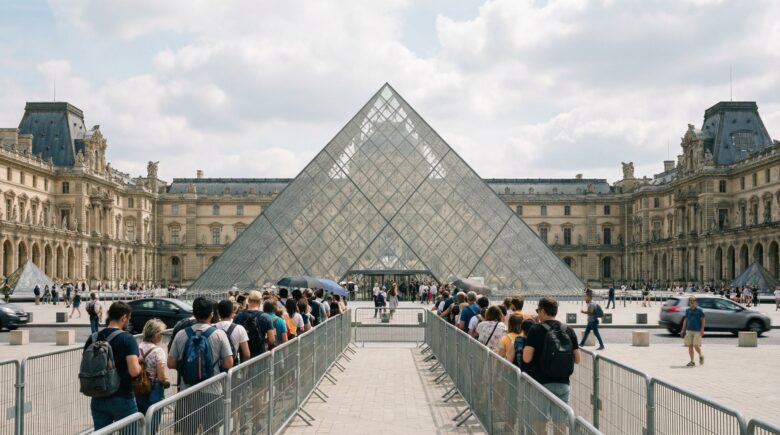
The main entrance to the complex is the glass pyramid located in the central courtyard. Designed by the architect I.M. Pei, it officially opened in 1989. At the time, the structure was highly controversial. Critics hated the mix of modern glass with classic French Renaissance architecture.
Today, it is a beloved symbol of Paris and serves a very practical purpose. It acts as a central skylight for the massive underground lobby that connects all three wings together.
Quick Facts for Your Visit
- Size: 72,735 square meters of art.
- History: Built as a fortress in 1190 and became a museum in 1793.
- Visitors: Approximately 9 to 10 million people visit every year.
- Must-See: The Medieval Moat located in the Sully Wing.
The Louvre is essentially a city within a city. You cannot conquer it in a single day, but you can certainly explore its many layers. Understanding these Louvre museum facts is the first step toward enjoying your visit.
You now understand the scale of this institution. To decide if you should dedicate a full day of your Paris trip to these galleries, read our honest review Is the Louvre Worth the Money and Time?