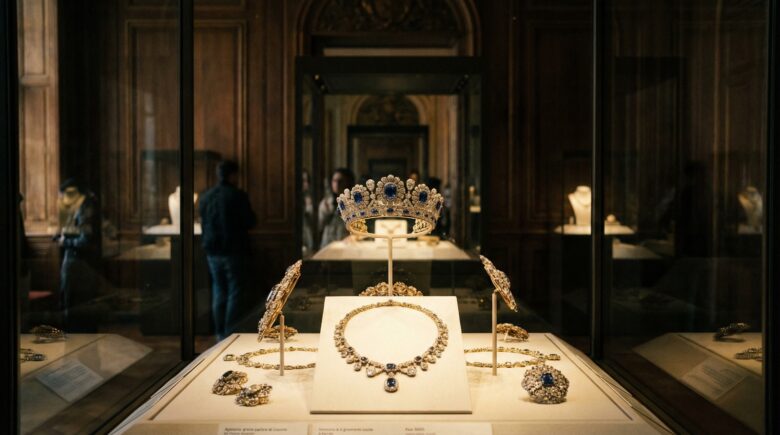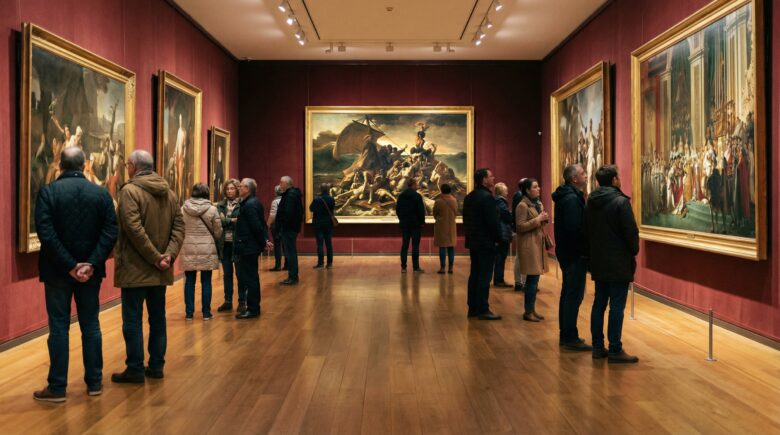
Most visitors spend their time looking at the paintings, yet very few actually look at the walls. This is a significant mistake because the Louvre is not just a container for art. The building itself is one of the most significant historical artifacts in Paris.
The Louvre Palace history spans over 800 years of evolution. It has transformed from a military bunker to a royal residence and finally to a public institution. Reading the architecture tells you the story of France itself.
The Medieval Fortress (1190)
King Philippe Auguste originally needed a defensive base to protect the city. Consequently, he built a thick fortress with a massive central tower to defend Paris. This structure was dark, cramped, and strictly military in its purpose.
You can still see the remains of this era today by visiting the lower level of the Sully Wing. You can walk through the original moat and see the base of the towers. Looking closely at the blocks reveals the original stonemason marks. It feels like a dungeon because that is exactly what it was during the earliest chapter of Louvre Palace history.
The Renaissance Transformation (1546)
By the sixteenth century, the old fortress had become obsolete for the needs of the monarchy. King Francis I decided to tear down the medieval tower and build a modern Renaissance palace. He wanted light, space, and intricate decoration to reflect his power.
His architect created the façade that you see in the Cour Carrée today. It remains a masterpiece of French design and signaled a major shift from war to luxury. At this point, the Louvre became the primary home of the French court and a symbol of cultural sophistication.
The Royal Residence and the Sun King
Successive kings added their own unique touches to the building. Henri IV built the Grand Galerie along the Seine to connect the Louvre to the Tuileries Palace. At over 400 meters long, it was likely the longest building in the world at the time.
Later, Louis XIV added the grand Colonnade on the east façade. However, the Sun King eventually lost interest in the city and moved the entire court to Versailles. As a result, the Louvre fell into disrepair for many years. Artists and squatters even moved into the empty ruins during this quiet period of Louvre Palace history.
The Birth of the Public Museum (1793)
The French Revolution changed the destiny of the palace forever. Once the monarchy fell, the revolutionaries declared that the King’s private art collection belonged to the entire nation.
On August 10, 1793, the Musée Central des Arts opened its doors to the public. This was a radical idea for the time because art was no longer just for the rich or the powerful. Instead, it became the property of every citizen. This transition turned the palace into a sanctuary for human achievement.
The Grand Louvre Project (1980s)
The most recent major transformation happened under President François Mitterrand. The museum was modernized to handle the massive influx of global tourists. For example, the Ministry of Finance was moved out of the Richelieu Wing to double the exhibition space.
The famous glass pyramid was added as the new central entrance to connect the sprawling wings underground. This project successfully turned the old palace into a functional modern museum while respecting the layers of Louvre Palace history beneath the surface.
Architectural Highlights to Spot
- The Apollo Gallery: This room was built for Louis XIV and served as the model for the Hall of Mirrors at Versailles.
- The Cour Carrée: This is the most symmetrical and peaceful courtyard in the entire palace complex.
- The Excavated Moat: You can find these 12th-century remains in the Sully Wing.
When you walk through these galleries, you are walking in the footsteps of Napoleon and the French revolutionaries. While the art on the walls is beautiful, the walls themselves witnessed the making of modern France. You should not ignore the palace because it is the biggest masterpiece in the entire collection.