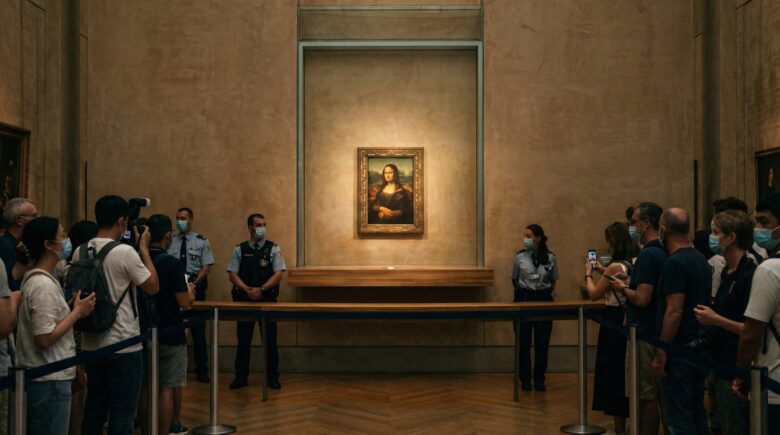
Theft is certainly not the only crime threat at the world’s largest museum. Instead, Louvre Museum vandalism is a much more frequent and unpredictable danger to the collection. Because artworks are inherently fragile and exposed, they have been targeted by unstable individuals and political protesters over many decades.
These incidents directly shape how the museum operates today. If you ever wonder why you cannot bring a water bottle near a painting or why security is so tight, these historical events are the primary reason.
- Alt Text: Protests and Louvre Museum vandalism have led to stricter security protocols.
Infamous Attacks on the Mona Lisa
The Mona Lisa unfortunately attracts the most abuse of any artwork in the building. While she looks calm, her protective case has survived several high profile attacks.
- The Rock (1956): A man threw a stone that shattered the glass and dislodged a speck of pigment near her left elbow. Consequently, she now sits behind bulletproof glass.
- The Teacup (2009): A visitor threw a ceramic mug at the case in a fit of rage. While the cup shattered into pieces, the painting remained completely unharmed.
- The Cake (2022): A man disguised in a wheelchair threw cake at the glass to draw attention to climate change. Staff simply wiped the cream away and the painting was safe.
- The Soup (2024): Protesters recently threw pumpkin soup at the glass to protest the agricultural system. Once again, the protective barrier did its job perfectly.
The Marker Incident and Liberty Leading the People
In 2013, an act of Louvre Museum vandalism occurred at the Louvre-Lens branch. A woman used a black marker to write on the famous painting Liberty Leading the People. She managed to write a short code near the bottom of the canvas before a guard tackled her.
Fortunately, expert conservators were able to remove the ink without any permanent damage to the masterpiece. However, this incident reminded the art world that significant damage can happen in just a few seconds even when guards are present.
Strange Burglary and Security Breaches
Beyond simple vandalism, the museum has faced strange security challenges. In 1983, a thief managed to steal a heavy Renaissance breastplate and a helmet. While these items were made of metal and very heavy, the thief successfully got them out of the building.
The mystery only ended years later when an antique dealer recognized the items and alerted the police. Additionally, activists have staged protests near the Venus de Milo. While they did not damage the statue itself, they created a massive security breach that highlighted how easily a group can disrupt the flow of the museum.
Why Do People Target the Art?
There are several reasons why individuals engage in Louvre Museum vandalism. For many, attacking a famous work of art is a guaranteed way to get global news coverage for their cause. Others may suffer from mental health issues or delusions triggered by the intensity of the art itself. Finally, because art is a powerful symbol of wealth and history, it becomes a target for those who want to protest the political system.
How This Affects Your Visit
Because of these past incidents, your visit to the museum is now much stricter.
- Bag Checks: Security searches every single bag for liquids, markers, or sharp objects.
- Physical Distance: Thick ropes and barriers now keep you much further away from the canvases.
- Glazed Works: Almost all major paintings are now protected behind glass.
The Louvre must constantly balance public access with the need for protection. Every time an act of vandalism occurs, that balance shifts slightly more toward security.