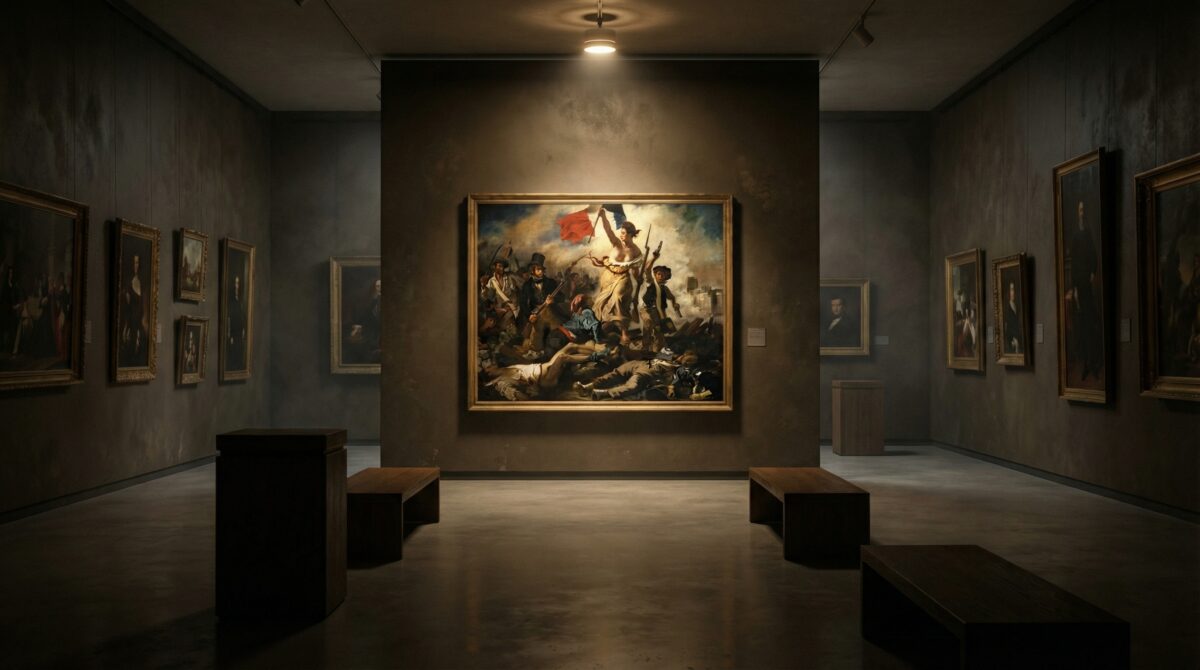
You have likely seen the famous flag and the guns in this iconic image many times. Consequently, you probably think of Marie Antoinette and the guillotine. You might even assume this is a painting of the French Revolution of 1789. However, you are actually wrong. This is the most common mistake regarding the Liberty Leading the People masterpiece. Eugène Delacroix did not paint the event that toppled Louis XVI. Instead, he painted a completely different revolution that happened forty years later. To truly appreciate the art, you must first understand the correct history.
The 1830 Setting of Liberty Leading the People
The year is 1830 and the famous revolution of 1789 is long over. Napoleon has come and gone, but the French monarchy is back in power. At this time, King Charles X sits on the throne. Because Charles X was unpopular, he tried to censor the press and dissolve the parliament. He essentially wanted to bring back the absolute power of the old kings. Eventually, the people of Paris decided they had had enough.
On July 27, 1830, the city exploded into violence. The citizens built massive barricades in the streets and fought the royal army for three days. These days are now known as Les Trois Glorieuses or The Three Glorious Days. This is the specific historical event you see in Liberty Leading the People by Eugène Delacroix.
Confusion Surrounding Liberty Leading the People
Why do so many people mix up these dates? Primarily, the revolutionaries of 1830 used the same symbols as their grandfathers in 1789. They brought back the Tricolor flag and sang La Marseillaise. Visually, the two revolutions look nearly identical. Additionally, pop culture influences like the musical Les Misérables confuse things further. That story takes place during a different rebellion in 1832, yet the imagery of the barricades blends them all together in the public mind.
The Role of Eugène Delacroix
Eugène Delacroix did not actually fight in the streets. He was thirty-two years old and watched the violence from his window. As he saw the smoke rising over Notre Dame, he felt a sense of guilt about not participating. He wrote a letter to his brother in October 1830 stating that while he may not have fought for his country, he would at least paint for her. He finished the work in just three months because he wanted to capture the energy while it was still fresh.
The Notre Dame Detail in Liberty Leading the People
There is a tiny historical detail in the background that proves the date. If you look at the towers of Notre Dame cathedral through the smoke, you will see a small Tricolor flag. During the Three Glorious Days, the revolutionaries climbed the cathedral and raised the flag to show they controlled the city. This specific moment happened on July 28, 1830. Delacroix recorded this fact like a journalist to anchor Liberty Leading the People in reality.
The Successful Aftermath and Final Verdict
The revolution of 1830 was successful, although it did not create a republic. Instead, it replaced one king with his cousin, Louis-Philippe. The government bought the painting in 1831 but quickly realized it was too dangerous. They feared the image of Liberty Leading the People was too inspiring and might start another riot.
Consequently, they hid it in an attic for many years. It did not enter the Louvre permanently until 1874. When you look at this French Revolution painting, remember that it is not about the start of democracy in 1789. Rather, it is about the persistence of freedom. It shows that the fight for liberty happens again and again. Delacroix captured that cycle of struggle perfectly.
The artist created a scene of raw courage and violence. Interestingly, he watched the fighting from his window instead of joining the battle. Discover his personal reasons in Why Delacroix Painted Liberty Leading The People But Did Not Fight.