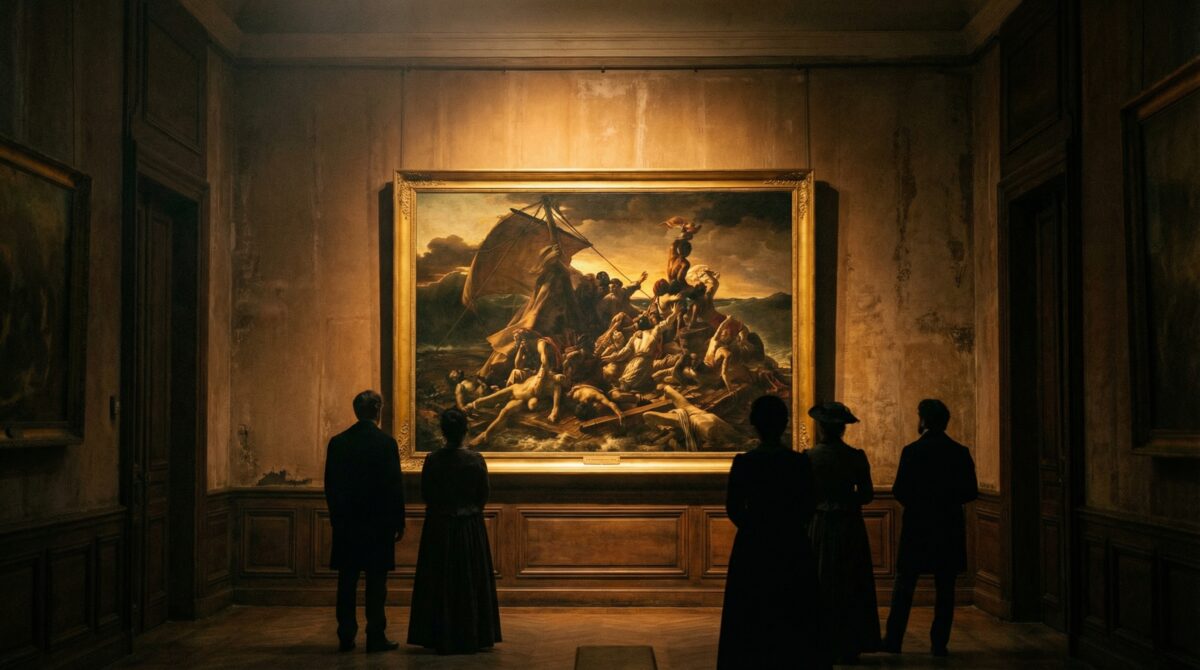
Eugène Delacroix was not a soldier. Instead, he was a dandy who loved fine clothes, dinner parties, and the opera. When the July Revolution of 1830 broke out, he did not pick up a gun. He chose to hide in his studio while the people of Paris fought and died in the streets. Yet, he eventually created the most powerful image of that violence. Liberty Leading the People by Eugène Delacroix is not a simple report from the front lines. Rather, it is a personal confession and an act of guilt painted on canvas.
The Artist on the Sidelines of Revolution
Delacroix was thirty-two years old in 1830 and a member of the upper middle class. Although he supported the idea of liberty, he deeply feared the chaos of the mob. On July 28, he watched the fighting near the Hôtel de Ville. This sight moved him deeply when he saw the Tricolor flag flying from the towers of Notre Dame.
In a letter to his brother, he explained that while he may not have fought for his country, he would at least paint for her. This quote reveals the true meaning of Liberty Leading the People. It was his way of participating in the struggle by using a brush instead of a musket.
How Liberty Leading the People Defined Romanticism
Delacroix served as the leader of the Romantic movement in France. Because Romanticism focused on intense emotion and movement, Liberty Leading the People was a radical departure from tradition. Before this work, art was dominated by Neoclassicism, where figures looked like calm marble statues.
- Chaos: The painting is intentionally messy. Smoke obscures the background while bodies lie in twisted piles.
- Color: Delacroix used loose and rapid brushstrokes to show energy.
- Emotion: The faces on the canvas are screaming, terrified, or determined.
While critics at the time called the work “ugly” or “dirty,” the public loved it because it felt real. They recognized that Liberty looked like a woman of the people rather than a distant goddess.
The Use of Color as a Weapon
Delacroix was a master of color who used it to guide your eye through the smoke. Specifically, he focused on the blue, white, and red colors of the French flag. The Tricolor in Liberty’s hand is the brightest point in the painting. Furthermore, the clouds echo these tones and the clothing of the fallen workers repeats the pattern. These repeated colors create a visual rhythm that shouts “France” from every corner of the canvas.
A Career Defined by Liberty Leading the People
Delacroix painted hundreds of works throughout his life, including lions in Morocco and religious scenes in churches. However, Liberty Leading the People remains his defining moment. This single work eventually overshadowed everything else he did and became the image of the French Republic itself.
Ironically, the new government bought the painting but immediately hid it. King Louis-Philippe knew the image was dangerous because it might encourage another revolution. Consequently, Delacroix did not see his masterpiece on public display for many years.
The Verdict on the Masterpiece
You might call Delacroix a hypocrite for not fighting in the streets. However, he understood his own strengths as an artist. While a bullet from his gun might have killed one soldier, this painting inspired millions of people. He captured the spirit of 1830 better than any historian of his time. Ultimately, he proved that an artist does not need to be a hero to create heroic art.
The canvas is a masterpiece of small symbols and hidden messages. You must look past the smoke to see the tiny clues left by the artist. Check our report on to see what you missed.