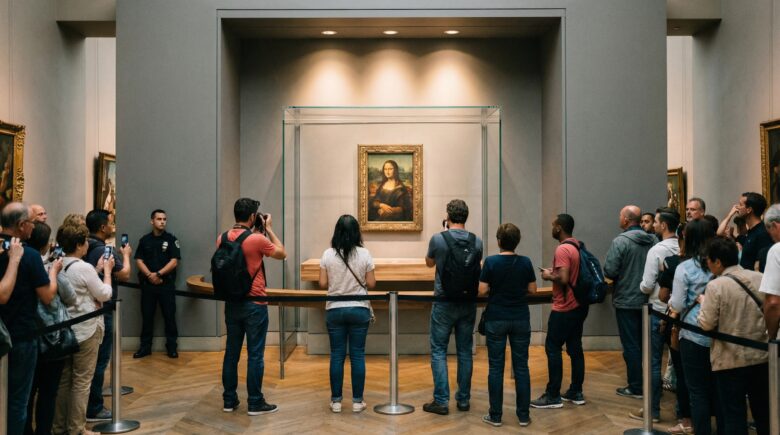
You stand before The Coronation of Napoleon in the Louvre. The lighting is realistic, and the scale is immense. It feels like a photograph of a frozen moment in time. But you are not witnessing history; you are witnessing a carefully constructed commercial.
Napoleon Bonaparte understood the power of branding. He didn’t want a record of the event—he wanted a masterpiece that legitimized his reign. He forced the artist, Jacques-Louis David, to rewrite history on canvas. Here are the five biggest lies in this famous masterpiece.
1. The Absent Mother
Look at the center of the gallery. A woman sits in a prominent chair, watching her son become Emperor. This is Letizia Bonaparte, Napoleon’s mother.
The Truth: She was not there. Letizia was in Rome, protesting Napoleon’s feud with his brothers and his marriage to Josephine. Napoleon didn’t care; he ordered David to paint her in the best seat anyway, famously stating he couldn’t allow history to see him without his mother.
2. The Pope’s Blessing
Pope Pius VII sits behind Napoleon, raising his hand in a gesture of blessing. He looks like a supportive ally of the new regime.
The Truth: In David’s original sketches, the Pope sat with his hands on his knees, looking passive and bored—which reflected his reality as a virtual prisoner forced to legitimize the event. Napoleon rejected the sketch, demanding the Pope be shown blessing the crown to suggest the Church’s full endorsement.
3. The Height of the Emperor
Napoleon was average height for his era, but in this painting, he dominates the room as a physical giant.
The Truth: David used several psychological tricks to make Napoleon Bonaparte look taller:
- The Platform: Napoleon stands on a raised step.
- The Posture: While others kneel or bow, Napoleon stands perfectly straight.
- The Isolation: Empty space is left around his head to draw the eye and establish dominance.
4. The Ageless Josephine
Josephine kneels before her husband with smooth skin and a slender, youthful figure.
The Truth: In 1804, Josephine was 41 years old—significantly older than Napoleon. Amid family pressure to divorce her for not producing an heir, her age was a political liability. David acted as a 19th-century “plastic surgeon,” painting her to look twenty years younger to protect her image and please the Emperor.
5. The Dutiful Sisters
The women holding the long velvet train of Josephine’s robe look like loyal, dutiful subjects.
The Truth: These were Napoleon’s sisters, and they were furious. They hated Josephine and initially refused to carry her train. During the actual ceremony, they reportedly pulled backward on the heavy velvet to make Josephine trip. David removed this family drama entirely, painting them as a unified front.
Why the Lies Matter
Napoleon understood that history is often written by the victors. He used painting the coronation of napoleon to “fix” his political problems:
- Family Feuds? Paint them united.
- Church Resistance? Paint the Pope blessing the crown.
- Empty Seats? Paint his mother in the center.
When you look at this artwork, don’t look for the truth. Look for ambition.
Jacques-Louis David did more than just paint a lie. He created a specific image of power to please the Emperor. You can learn about the relationship between the painter and the ruler in our article on The Pop Culture Legacy of Liberty Leading the People.