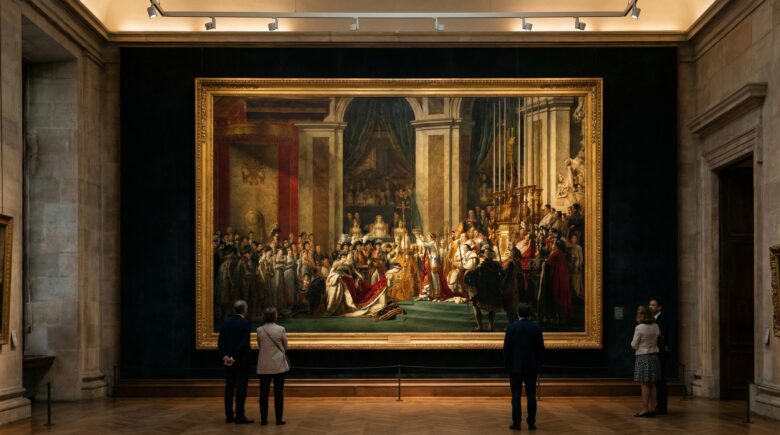
You can meet the Emperor in two unique places in Paris. First, you can visit the Louvre Museum. Here, you see the famous Coronation of Napoleon painting. The artwork is loud, gold, and full of life. Alternatively, you can explore Les Invalides. Inside this building, you will find the silent Napoleon tomb. Heavy red stone forms this cold monument. Therefore, you should visit both sites to truly understand the man. The painting shows his dream, while the tomb represents his final reality.
The Height of Glory The Coronation
The massive painting in the Louvre captures the exact moment Napoleon became a god.
- Setting. Notre Dame Cathedral.
- Mood. Pure celebration.
- Message. I am the future.
Back in 1804, Napoleon Bonaparte was completely invincible. For instance, the young general had already conquered Italy and rewritten the laws of France. At that time, the new Emperor was only 35 years old. Consequently, the painting looks incredibly crowded because everyone wanted to be near him. Furthermore, the artist focused the bright light directly on the ruler because he acted as the center of the French world.
The Depths of Exile The Death
However, the Empire vanished just 17 years later. All the royal gold was gone. Eventually, Napoleon died on Saint Helena, which is a tiny island in the middle of the Atlantic Ocean. The British kept him there as a strict prisoner. During this exile, the former ruler felt lonely, sick, and totally defeated. The fallen Emperor was 51 years old at the time of his death. After he passed away, soldiers buried his body in a nameless grave under a simple willow tree. His remains actually lay in the mud for 19 years. Ultimately, this marked the tragic end to the bright story the coronation painting originally began.
The Return The Tomb of Napoleon Bonaparte
France obviously could not leave Napoleon the Great on a British island forever. Therefore, King Louis Philippe negotiated the return of his ashes in 1840. People call this famous historical event the Return of the Ashes. Soon after, a massive funeral procession carried his recovered body straight through the Arc de Triomphe to the Dome des Invalides.
Inside the Tomb
Inside the building, the Napoleon tomb stands as a true masterpiece of design. The talented architect Visconti created the space with several highly intentional details.
- The Open Crypt. First, you enter the Dome church and look over a marble balcony. A massive sarcophagus stands right in the center of a circular pit. Because of the layout, you must physically bow your head to look down at it. The designer planned this intentionally so every single visitor bows to the Emperor.
- The Red Quartzite. Red quartzite from Russia forms the massive sarcophagus. This material features a deep brownish red color that closely resembles dried blood. Additionally, the heavy stone rests on a thick base of green granite.
- The Nesting Dolls. Finally, six separate coffins hold Napoleon inside the crypt. These protective layers include tin sheet iron, mahogany, lead, ebony, oak, and the final red quartzite outer shell.
The Statues of Victory
Twelve massive statues called the Victories surround the crypt. White marble forms these imposing female figures, and they stand guard forever. Down on the floor, a colorful mosaic lists his greatest battles like Rivoli, Pyramids, Marengo, and Austerlitz.
Interestingly, you will notice that Waterloo is missing from the floor list. The monument proudly celebrates the victories, but it completely ignores the major defeats. Just like the Coronation painting, the tomb acts as a carefully curated version of history.
Why You Should Visit Both
You should definitely start your historical journey at the Louvre. Go see the man who crowned himself, and admire the stunning beauty of the coronation. Afterward, go to the Napoleon tomb to experience the intense silence of his final rest. Together, these two unique sites perfectly tell the full story of a man who permanently changed the world.