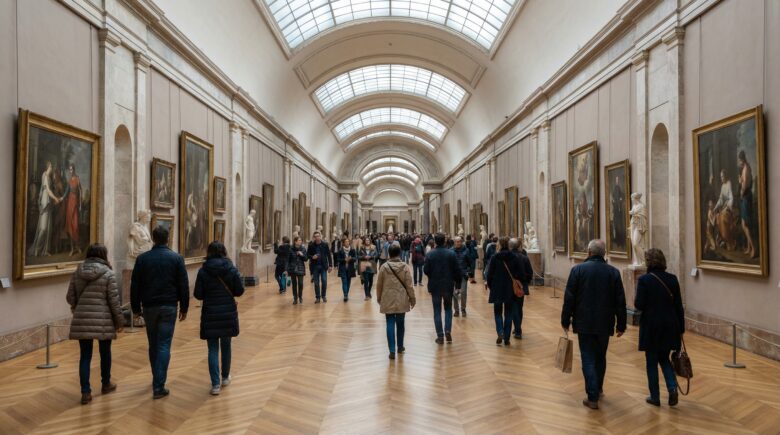
It is an incredibly common mistake for travelers to look at a map of Paris and decide to “do the Louvre” on a Tuesday. They often imagine they will simply walk into every room and see every single painting. However, this is a complete fantasy because the building is officially the largest art museum on the planet. The Louvre museum size is difficult to fully comprehend until you are standing inside its massive halls. Understanding the actual numbers helps you plan a much more realistic visit.
The Numbers Behind the Masterpieces
Let us look at the data to understand the physical scale of the building. The total exhibition space covers 72,735 square meters, which is roughly the size of fifteen football fields. Furthermore, there are over 35,000 works of art on display at any given time. If you attempted to walk through every single room without stopping, you would cover a distance of roughly eight miles. Consequently, the Louvre museum size makes a casual stroll through the entire collection an impossible task.
The Math of Viewing the Collection
Imagine for a moment that you are a machine that does not need to eat or sleep. If you spend exactly thirty seconds looking at each object in the collection, the math is quite shocking.
- Total Minutes: 35,000 objects multiplied by 30 seconds equals 17,500 minutes.
- Total Hours: 17,500 minutes equals roughly 291 hours of constant viewing.
- Total Days: 291 hours equals twelve full days of 24-hour observation.
Since the museum is only open for about nine hours a day, it would take you over a month of daily visits to give everything just a 30-second glance. Because of this reality, you must accept that you can only see a fraction of the works.
Understanding the “Museum Fatigue” Factor
Even if you could physically sprint through every gallery, your brain would eventually shut down. This common phenomenon is known as “museum fatigue.” After about two hours of intense focus, your ability to appreciate art drops significantly. The one-hundredth masterpiece you see will not look as special as the first one you encountered. Because your brain gets saturated with colors and history, you stop seeing art and start seeing simple objects on the walls.
Prioritizing Quality Over Quantity
Since you cannot see everything, you must actively choose what to see during your visit. A successful trip is about curation and you are the curator of your own experience. You should pick three specific departments, such as Greek sculpture and the Crown Jewels, and focus exclusively on those areas.
You should feel comfortable walking past the other rooms without feeling guilty. This strategy allows you to maintain your energy levels while ensuring you actually enjoy the art you came to see.
The Multi-Day Strategy for 2026
If you truly want to see a large portion of the collection, you should buy a ticket for two different days. This approach allows you to split the Louvre museum size into manageable chunks.
- Day One: Focus your energy on the Denon Wing and the Italian Renaissance.
- Day Two: Focus on the Richelieu Wing and Northern European masterpieces.
Splitting the visit keeps your mind fresh and ensures you enjoy the second day much more than the sixth hour of a single marathon session. You should accept that you will miss famous things and prioritize a “must-see” list of five items. Anything else you see is simply a bonus.
One day is a short window for such a massive collection. You must avoid losing hours in long lines to make the most of your ticket. Learn how to navigate the museum efficiently in Beat the Crowds at the Louvre Museum Smart Queue Tips.