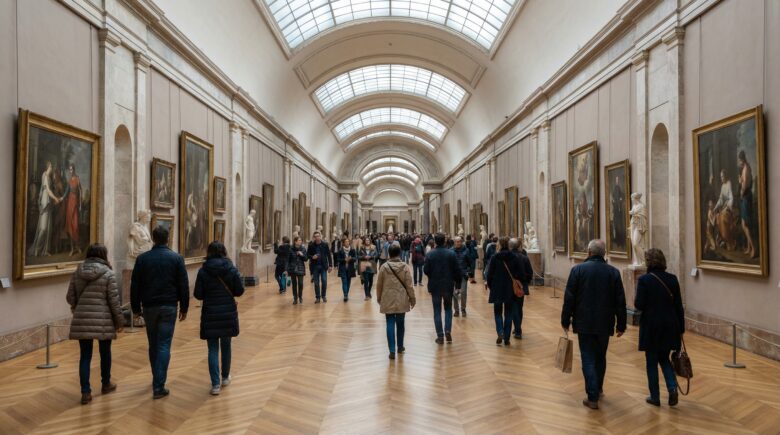
The Louvre is not just a gallery for beautiful paintings. Instead, it is a massive history museum where the collection of ancient objects rivals any institution on the planet. You can stand in front of artifacts that were created long before the Bible was even written. If you are interested in the origins of human society, you must visit the Louvre Museum antiquities found in the Near Eastern and Egyptian departments.
The Code of Hammurabi
This basalt stele is one of the most important documents in human history. You can find it in the Richelieu Wing on the ground floor. It looks like a giant black index finger pointing at the sky and is covered in fine cuneiform writing.
Because it dates back to 1754 BC, this stone contains the ancient laws of Babylon. This is specifically where the concept of “an eye for an eye” was first codified. Consequently, you are looking at the very foundation of modern law. The top of the stone shows King Hammurabi receiving the laws from the sun god, which serves as a powerful symbol of divine authority.
The Great Sphinx of Tanis
While everyone knows the Sphinx in Giza, the Louvre has its own massive giant. The Great Sphinx of Tanis guards the entrance to the Egyptian collection in the Sully Wing. It is carved from solid rose granite and features the body of a lion with the head of a king.
This is one of the largest sphinxes located outside of Egypt. Although it is thousands of years old, the polish on the stone remains remarkably smooth. This statue remains a highlights of the Louvre Museum antiquities because it radiates ancient power and mystery.
The Persian Frieze of Archers
Nearby in the Persian section, you will find the stunning Frieze of Archers. These are glazed brick walls taken from the palace of Darius I in Susa. The colors are truly incredible because the bright blues, greens, and yellows have survived for over 2,500 years.
The bricks show soldiers carrying spears and bows in a repetitive pattern. This repetition creates a visual rhythm that gives you a sense of the immense scale of the Persian Empire. It is a masterpiece of ancient engineering and artistic design.
The Egyptian Mummy
No visit to the Egyptian wing is complete without seeing an actual mummy. The Louvre holds an extremely well-preserved mummy of an unknown man from the Ptolemaic period. The intricate wrapping of the linen bandages is an art form in itself. It serves as a somber and fascinating reminder of how ancient cultures viewed death and the afterlife.
Why These Artifacts Matter Today
While paintings show you what an artist imagined, these Louvre Museum antiquities show you how people actually lived.
- Law: The Code of Hammurabi shows how ancient leaders ruled their people.
- Power: The Sphinx shows how they worshipped their god-kings.
- War: The Archers show how they prepared for battle and defended their borders.
Essential Visitor Tip
The antiquities sections are often crowded with school groups during the morning hours. Therefore, you should try to visit these wings during lunch hours or on Friday nights. The lighting on the stone sculptures is particularly moody and beautiful in the evening. You should not just look at the paintings in the Louvre. Instead, you should go look at the stones that actually built our civilization.